Jane Dunnewold’s Work: Visually Complex, Distinctive, Beautiful
By JASMINA WELLINGHOFF, Editor –
Jane Dunnewold is the first fiber artist to be named artist-of-the-year in San Antonio Arts League’s 74-year history of honoring exceptional San Antonio artists. Asked about how she felt about this significant moment in her career and in the history of fiber arts, Dunnewold admitted that “It was thrilling.”
But she didn’t believe she was going to be selected.
“When I was contacted and they told me I had been nominated, they (SAAL) asked for a statement and twenty images, and some additional stuff, and I thought, Ah! There’s no way they’ll ever pick me. Maybe I shouldn’t even bother sending the materials,” she recalled during a recent interview. “But then my husband said, ‘If you don’t play, you can’t win.’ So, I realized it was quite an opportunity no matter how it turned out.”
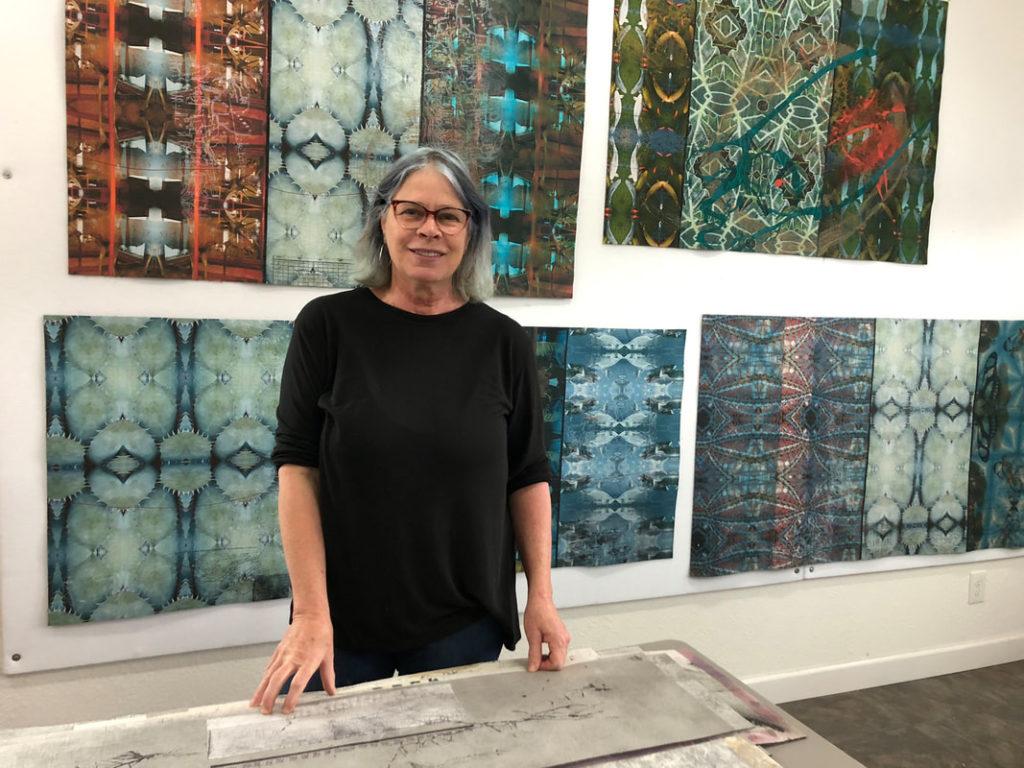
The current exhibit at the San Antonio Art League Museum is essentially a retrospective of Dunnewold’ s work, representing different phases of her artistic interests and output. The show is organized in several sections titled Beginnings, Sacred Planet, Etudes, Quilt/Not Quilt, Transitions and Botanicals.
“I want art I make to tell stories,” Dunnewold wrote in the show catalog, but her images are not narratives. They are “visually poetic stories,” she noted, that developed in parallel with how she developed as a human being and as an artist, creating her own visual vocabulary, exploring new materials, themes and techniques.
The Etudes pieces “were approached as meditations” in her studio, she explained, resulting in images that communicate a sense of tranquility, with their soft tones, symmetries and blurred, seemingly unfinished shapes. The Sacred Planet series, on the other hand, reflects her desire to honor nature as does the Botanical group. But the two series are visually quite different. While Sacred Planetimages pack layers of content in fabulously intricate designs, the Botanicals tell their story in more direct ways – as leaves, flowers and branches – in muted colors against golden backdrops.
What is so distinctive about her entire body of work is the variety of materials and techniques she employs to achieve different effects, everything from dyeing, photography and screen printing to stitching, sanding, hand embroidery, old quilt patches, and more. No wonder, she prefers to call herself a mixed media artist these days.
“I like the paradox and humor of combining something that was originally functional with its non-functional version,” she said referring to some of her “quilt” pieces. “I think people take boundaries too seriously and that’s one of our problems in the art world. If you can take something that used to be soft on a bed and put spackle on it and make it hard and put it on the wall as art, that opens the question: What is and what isn’t art?”
Dunnewold studied psychology and religion in college but fate clearly had other plans for her. Though she did take a few hobby-type classes along the way, she likes to describe herself as self-taught. A couple of decades ago, she talked her way into a job at the Southwest Craft Center – now the Southwest School of Art – and eventually became the chair of the Surface Design Studio there, a position she held for 11 years. Today, she is an internationally recognized authority on fiber arts, the author of several books – including Complex Cloth and Art Cloth – and a teacher who spends a lot of time traveling and leading a variety of workshops. Her work has been shown in solo and group exhibits, and she is the recipient of a number of awards, such as the Quilt Japan Prize and the Gold Prize at the Teague (Korea) International Textile Exhibition. She’s particularly proud of her participation at the International Festival of Quilts in Birmingham, England, in 2010, an event that’s “a huge deal” in Europe. In 2017, the McNay Art Museum exhibited her mixed media series featuring re-purposed quilt blocks and gold leaf.
Considering the growing popularity of fiber art, why was the art community so reluctant to accept it as a legitimate art form?
“Fiber art started as functional textiles such as quilts and clothing and there were rules how it had to be done. Art doesn’t have any rules. Because it had been women’s work and because it had to be functional, it was hard for the art world to consider it as anything other than functional and decorative,” she explained. “All those ideas are blurring now because young people going to art school don’t think about the hierarchy of materials the way former generations did. They use whatever works in order to make a point. Younger artists are gravitating toward the materiality of textiles and like using fabrics in their work and incorporating those elements in mixed media.”
Having covered fabric art in her previous books, Dunnewold is now hard at work on her next manual focusing on botanical prints, which start with real leaves and blooms. Undoubtedly, it will become another textbook for hundreds of artists looking to explore a different medium. And there’s another significant exhibit coming soon. In November, the National Quilt Museum in Paducah, Kentucky will showcase yet another of her series, not included in the SAALM show. “That’s a big deal for me, to be recognized on that level,” said the artist.
———————————————-